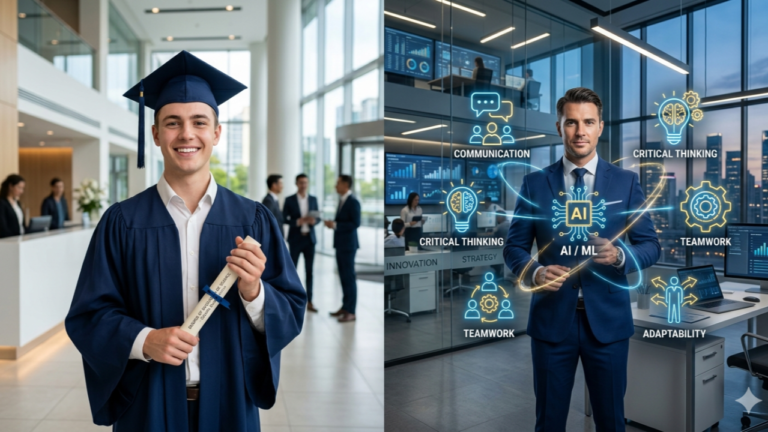
There was a time—not too long ago—when the path felt almost pre-written. School, college, degree, job. Simple. Predictable. Safe, even.
But something’s been shifting. You can feel it in conversations, in job descriptions, in the way people talk about “learning” now. It’s less about where you studied, and more about what you can actually do.
And honestly, that shift has left a lot of people wondering… did we get it wrong all along?
The Old Promise of Traditional Degrees
Degrees were once a kind of golden ticket. You put in the years, earned the qualification, and doors would open.
To be fair, they still do—especially in fields like medicine, law, or engineering where structured education is non-negotiable. A surgeon can’t exactly learn through YouTube tutorials.
But outside those domains, the value of a degree has become… a bit complicated.
Graduates often step into the job market with theory-heavy knowledge but limited practical exposure. Employers notice that gap. And sometimes, it becomes the very thing that holds candidates back.
The Rise of Skill-Based Learning
Now here’s where things get interesting.
Skill-based learning isn’t new, but it’s having a moment. People are learning through online platforms, bootcamps, real-world projects, even freelancing gigs. It’s faster, more flexible, and—let’s be honest—often more relevant to actual work.
A graphic designer today might never have attended a formal design school, yet still land high-paying clients. A coder might learn everything through platforms like Coursera or Udemy and build a portfolio that speaks louder than any degree.
The rules are changing, quietly but steadily.
So What’s Really Driving This Shift?
Part of it is speed. Industries evolve faster than traditional education systems can keep up. By the time a curriculum updates, the market has already moved on.
Then there’s accessibility. Not everyone can afford years of formal education. Skill-based learning opens doors without demanding huge investments of time and money.
And maybe most importantly—proof of work matters more now. Employers want to see what you’ve built, not just what you’ve studied.
The Big Question Everyone’s Asking
Somewhere in all this, the question naturally comes up—Skill-based learning vs traditional degrees: future kis taraf ja raha hai?
The honest answer? It’s not a clean split.
The future isn’t about choosing one over the other. It’s about how both evolve and overlap.
Degrees are slowly becoming more skill-oriented, while skill-based learning is becoming more structured. The lines are blurring.
Where Degrees Still Hold Strong
It would be unfair—and inaccurate—to say degrees are losing relevance completely.
They still offer something valuable: depth, discipline, and a broader understanding of a subject. They also provide networking opportunities, exposure to diverse ideas, and a sense of academic grounding.
In many industries, especially those with strict regulations, degrees remain essential.
And for some people, the structured environment of a college is exactly what they need to learn effectively.
Where Skills Take the Lead
On the other hand, skill-based learning shines in fast-moving industries.
Tech, digital marketing, content creation, design—these are fields where practical ability often outweighs formal credentials. You can’t fake skill for long. Either you can do the work, or you can’t.
And because these industries evolve so quickly, continuous learning becomes more important than a one-time degree.
It’s less about where you started and more about how you keep growing.
The Real Advantage Lies in Combination
Here’s where things start to make sense.
People who combine both approaches—formal education plus practical skills—tend to stand out the most. They have the theoretical foundation and the ability to apply it.
It’s like having both a map and the ability to navigate terrain. One without the other can still work, but together, they’re far more powerful.
A Shift in Mindset
What’s really changing isn’t just education—it’s how we think about it.
Learning is no longer a phase that ends after college. It’s ongoing, messy, and often self-directed. People are picking up new skills mid-career, switching fields, experimenting more.
There’s less pressure to “get it right” the first time.
And maybe that’s a good thing.
The Emotional Side of the Debate
There’s also a quieter, more personal layer to this conversation.
For many, degrees represent security, validation, even family expectations. Moving away from that path can feel risky, sometimes even rebellious.
At the same time, skill-based learning offers freedom—but also uncertainty. No fixed roadmap, no guaranteed outcome.
So the choice isn’t just practical. It’s emotional too.
Final Thoughts
The future of education isn’t about replacing degrees with skills or vice versa. It’s about adapting to a world where both have a place—and where neither is enough on its own.
If anything, the real skill might just be learning how to learn. Staying curious. Staying flexible.
Because in a world that keeps changing, that’s the one thing that never really goes out of date.